Twenty minutes’ walk from the old port, La Ciotat hides two coves of the Calanques National Park: Mugel and Figuerolles. Both sit at the foot of the Bec de l’Aigle cliff, yet they feel completely different. Here is our local guide: how to get there, where to park, where to swim, and the two places where we take our own friends.
At a glance
- Mugel: pebble beach with a gentle slope into the water, ideal for families. A listed botanical park right next door and a restaurant with its feet in the water.
- Figuerolles: wilder, 87 steps down, spectacular cliffs. At the back of the cove, the legendary restaurant of the “Independent Republic of Figuerolles”.
- From the old port: about 15 to 20 minutes on foot to Mugel, 25 minutes to Figuerolles.
Mugel calanque
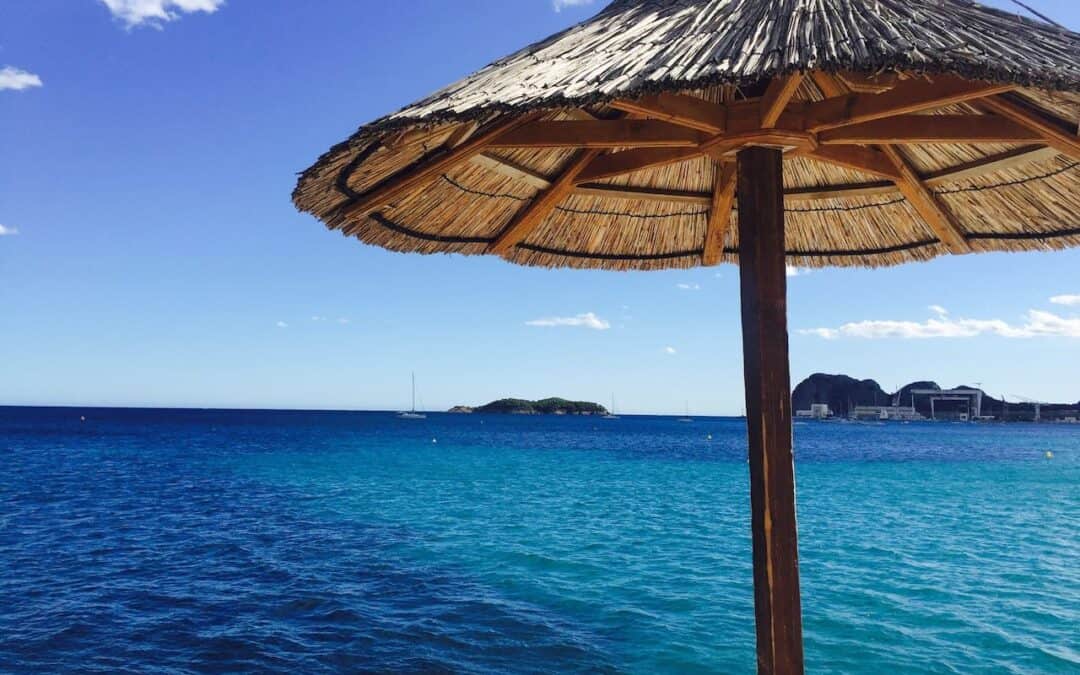
Mugel is La Ciotat’s largest calanque. It has two coves, the Grand Mugel and the Petit Mugel, facing the Île Verte island beneath the ochre bulk of the Bec de l’Aigle. The beach is made of small colourful pebbles and the water deepens very gradually, which makes it one of the easiest coves with children. Lifeguards are on duty in season.
One detail: to the left you can see the cranes of the shipyard. It’s part of La Ciotat’s charm, where industry meets wild nature.
Good to know
- Dogs are not allowed on the beach.
- Bring water shoes, a mask and a snorkel: the rocky seabed is beautiful.
- From Mugel you can paddle or kayak across to the Île Verte, as long as you’re careful and check the weather.
Le Mugel restaurant
Right in the cove, Le Mugel restaurant serves Mediterranean food with a focus on fish and seafood, on a terrace by the water looking out to the Île Verte. It’s the perfect spot to go from a swim to lunch without getting back in the car. It only opens in season and closes in winter. In summer, book ahead: the sea-view tables go fast.
Parc du Mugel: our favourite
Just above the cove, the Parc du Mugel is one of the most beautiful gardens on this coast. Created in the 19th century by a keen botanist, it enjoys a genuine microclimate: the Bec de l’Aigle shelters it from the mistral wind and sea spray. As a result, tropical and Mediterranean species thrive here like nowhere else in the area. Now owned by the town, it carries the French “Jardin remarquable” (Remarkable Garden) label.
Across a dozen hectares you’ll wander through palm groves, bamboo, cacti, citrus trees and cork oaks. Picnic areas and a children’s playground make it easy to spend the whole day.
The viewpoint, 82 metres above the sea
Don’t leave without climbing to the belvedere. The path is steep but short, and the reward is huge: a panorama over the bay of La Ciotat, the Île Verte and the open sea. At the end of the day, it’s one of the finest sunsets on the coast. Another loop leads to the Anse du Sec viewpoint, not recommended if you suffer from vertigo. The climb isn’t suitable for pushchairs.
Practical info
- Free entry.
- Approximate opening hours: 8am-8pm from April to September, 9am-6pm from October to March.
- Access can be restricted on days of high wildfire risk, especially in summer: check the “Accès aux massifs” page on the La Ciotat tourist office website before you go.
Figuerolles calanque
A few minutes from Mugel, Figuerolles is a whole different scene. A staircase of 87 steps leads down to a small pebble cove, wedged between puddingstone cliffs sculpted by erosion, with the Bec de l’Aigle as a backdrop. The water is deep and intensely blue, perfect for snorkelling.
- There’s no drinking water: bring your own.
- The cove is small: in July and August, arrive early in the morning.
- The steps can be slippery, so avoid flip-flops on the way down.
Chez Tania, the “Independent Republic of Figuerolles”
At the back of the cove hides a La Ciotat institution: Chez Tania, the hotel-restaurant of the RIF, the “République Indépendante de Figuerolles”, self-proclaimed with a wink. It was founded in 1956 by a Russian family who settled in the cove, and their descendants still run it today. The Gault&Millau guide even tells how the “republic” was created by a Russian exile and a former pilot of the Normandie-Niemen squadron.
You eat on terraces stepped into the rock, shaded by fig trees. In the evening the cliffs are lit up, and it’s magical. Expect Provençal and Mediterranean cooking, fish and bouillabaisse. For us, it’s the one unmissable experience of a stay in La Ciotat.
- Open all year round, lunch and dinner (roughly 12-1.30pm and 7-9.30pm, check depending on the season).
- Booking is essential, especially in summer and at weekends.
- Full details at figuerolles.com.
Getting there and parking
On foot: the best option
From the old port, follow the quays south towards Mugel: allow 15 to 20 minutes to Mugel calanque, then a few more minutes to Figuerolles. The walk is part of the fun.
By bus
Local buses serve the Mugel and Figuerolles stops. Timetables are on the network’s website, laciotat.rtm.fr.
By car
- Mugel car park, avenue des Calanques: the largest, a few minutes’ walk from the beach. As far as we know, the first hours are free, then it’s paid.
- Figuerolles car park: small, right above the steps, and full very early in summer. The easiest option is to park at Mugel and walk about 800 metres.
In high season, we honestly recommend leaving the car behind and walking.
Our tip: walk there from the old town
Our 85 m² duplex sits in the heart of old La Ciotat, 150 m from the sea and 3 minutes from the old port. You can walk to Mugel and Figuerolles without hunting for a parking space, then head back for a shower before dinner at Chez Tania. It sleeps up to 6 people, with 3 bedrooms, 2 bathrooms and air conditioning.
Read also: the best beaches in La Ciotat, 10 things to do in La Ciotat and where to stay in La Ciotat.
Recent Comments